
Most people return from vacation feeling only marginally less depleted than when they left. Not because they didn’t try to relax, but because they never actually disconnected. The phone stayed on. The work emails kept arriving. The mental tab labeled “things to check” never fully closed. True unplugging isn’t a personality type reserved for the chronically zen — it’s a skill, and like most skills, it requires preparation, deliberate choices, and a willingness to be briefly uncomfortable before it starts to feel good.
Why Partial Disconnection Barely Counts

There’s a meaningful difference between reducing screen time and genuinely stepping away. Most vacationers attempt the first and believe they’ve achieved the second. Research on cognitive recovery consistently finds that the brain needs sustained periods without task-switching to fully restore attentional capacity. Checking email once a day still primes the anxiety loop — the act of opening the inbox, even briefly, re-engages the same stress response as staying fully connected.
The practical implication: half-measures extend your recovery timeline without giving you the full benefit of either approach. If you’re going to stay partially connected for legitimate reasons — a business that genuinely cannot go two weeks without you — build one defined window per day, a specific 20-minute slot, rather than treating your phone as occasionally off-limits. That structure is psychologically different from ambient availability. Everything else is theater.
The Pre-Trip Setup That Actually Makes Unplugging Possible
Most failed attempts to disconnect trace back to inadequate preparation, not weak willpower. The goal before departure is to eliminate the friction that pulls you back online. That means several concrete steps:
- Set an out-of-office reply at least 48 hours before departure, not the morning you leave, so incoming contacts adjust expectations before urgency builds.
- Identify one specific person — a colleague, assistant, or trusted contact — who holds genuine decision-making authority for issues that arise, and brief them on the two or three scenarios most likely to occur.
- Forward any time-sensitive logins or documents they might need rather than leaving yourself as the bottleneck.
For travelers with pets, arrangements like pet boarding should be confirmed and paid in advance so there’s no logistical reason to check in repeatedly with a facility while you’re away.
The goal isn’t to disappear without a trace. It’s to construct a situation where the world functions reasonably well without your constant monitoring — because that’s the only condition under which your nervous system will believe it’s safe to rest.
Choosing the Right Environment for the Kind of Reset You Need
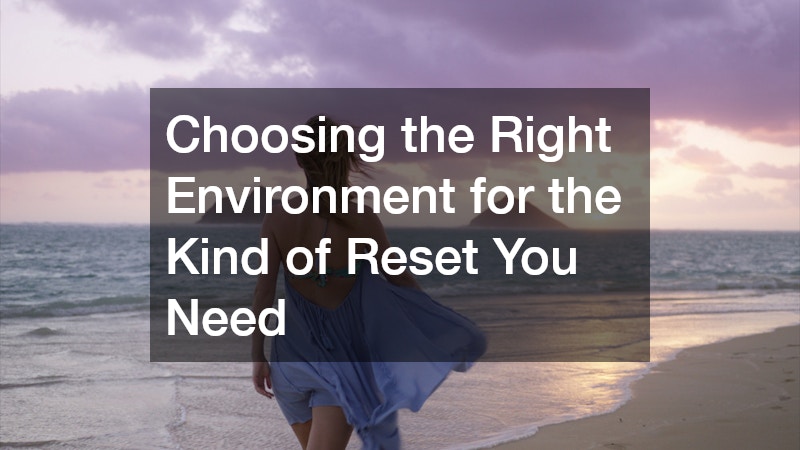
Not all vacations produce the same quality of mental recovery, and the environment you choose matters more than the duration. A week at a resort with unlimited poolside Wi-Fi and an active social program may be genuinely refreshing for one person and deeply ineffective for another.
The relevant variable isn’t luxury versus budget — it’s stimulation level. High-stimulation environments (busy cities, large group tours, event-driven itineraries) suit people who decompress by filling the mind with something different from work. Lower-stimulation settings (remote rentals, national park trips, beach towns with minimal nightlife) work better for people who recover by emptying the mind entirely. The mistake is choosing based on what looks appealing on social media rather than what your specific nervous system actually needs.
A useful self-assessment: think back to the last trip where you felt genuinely restored on return. What was the pace? How many decisions did you make per day? That data point is more reliable than any travel trend.
Managing Technology Without Becoming Militant About It
Total phone abstinence isn’t realistic or even necessary for most people, and treating it as a moral imperative tends to produce more anxiety, not less. The more functional approach is a hierarchy of use.
Navigation and logistics apps: use freely, they reduce friction. Photography: fine, but set a personal limit — shooting more than 15 to 20 photos a day on a leisure trip tends to shift the brain from experiencing to documenting, which is a form of work. Social media: the strongest evidence for its interference with psychological recovery points to passive scrolling rather than active posting; if you must engage, posting a photo is far less cognitively costly than reading feeds. Email and work messaging: full stop, off, redirected.
Some travelers find that a dedicated travel device — an older phone with work accounts removed — solves the problem structurally rather than relying on willpower. The barrier of switching devices adds enough friction to interrupt automatic checking behavior.
Rebuilding the Habit of Being Present
The first two days of a real digital detox are often the most uncomfortable, not because anything urgent has happened, but because the compulsive reach for the phone is a conditioned behavior. Expect the impulse. Plan for it.
Replacement behaviors that genuinely compete with phone-checking share two qualities: they require mild physical engagement and produce immediate sensory feedback. Walking, swimming, cooking a meal from local ingredients, sketching, or reading physical books all qualify. Passive activities like lying on a beach without a replacement behavior tend to leave the checking impulse unaddressed.
By day three or four, most people report a noticeable shift — slower thought patterns, more interest in immediate surroundings, and longer attention spans. That shift is the actual goal of the vacation. Everything before it is transition cost.
Coming Back Without Undoing the Reset
Re-entry is where the recovery gains most often collapse. Returning Sunday night and reading two weeks of email before bed effectively erases the psychological distance you built. Build in a deliberate buffer: return at least one full day before work resumes, and treat the first re-entry session as a triage exercise — flag only what is genuinely urgent, defer everything else to a scheduled review block the following morning.
One practical technique is the “zero expectations” first hour: spend 60 minutes on purely physical re-entry tasks (unpacking, laundry, grocery run) before opening any device. It signals to the brain that life at home is not an emergency.
Deciding What Kind of Vacation to Actually Take
The deeper question underneath all of this is whether your vacation serves recovery or performance — whether you’re resting or producing content, social proof, and experiences worth reporting. Those are genuinely different trips, and there’s no obligation to choose one over the other every year. But knowing which you’re taking before you leave determines every other decision: destination, pacing, technology rules, and what success actually looks like when you come home.