Six months might sound like a sprint when you consider that some couples spend a year or more planning their big day. But here’s the encouraging truth: a six-month timeline is not only doable, it’s actually how a huge number of real weddings come together. The key isn’t working harder than everyone else — it’s working in the right order, with realistic expectations about where your money and time actually go.
Two recent data points make that last part easier to plan around. According to The Knot’s 2026 Real Weddings Study, which surveyed over 10,000 U.S. couples married in the past year, the average wedding now welcomes around 117 guests at a cost of roughly $290 to $300 per person. Meanwhile, Zola’s 2026 First Look Report — based on one of the largest wedding surveys ever conducted — found that venue costs alone average $8,573, or about 17% of a couple’s total budget, making it the single biggest line item most people book. Put those two numbers together and you get a clear planning principle: your guest count drives your total cost more than almost anything else, and your venue decision should happen early, fast, and with your real budget in hand — not the other way around.
Six months also means you’re skipping the year-plus courtship some couples have with their planning spreadsheets, which can actually work in your favor. A shorter runway forces decisiveness, cuts down on decision fatigue, and often means you’re less tempted to keep second-guessing choices you already made. The tradeoff is that there’s very little room for procrastination — a month lost to indecision on a six-month timeline is a much bigger deal than the same month lost on a twelve-month one.
This guide walks through exactly what to prioritize each month, what most couples underestimate, and how to keep six months from feeling like six sprints to the finish line. Think of it less as a rigid schedule and more as a sequencing strategy: certain decisions genuinely need to happen before others, and getting that order right is what separates a calm six months from a frantic one.
Month 6–5: Lock In Your Vision and Venue
The first six weeks of engagement are less about picking colors and more about making a handful of foundational decisions that everything else depends on. Skip this stage, or rush it, and you’ll spend the rest of your planning window backtracking.
Set Your Budget Using Real Numbers
Before you fall in love with anything, sit down with your partner (and anyone contributing financially) and put a number on paper. This is where that per-guest data point becomes genuinely useful. If your realistic guest count is 100 people and the national average cost per guest sits around $290–$300, you’re looking at a starting baseline in the neighborhood of $29,000–$30,000 before any personal splurges. That’s not a rule — plenty of couples spend far less by making smart substitutions — but it’s a far better starting point than guessing.
A simple way to build your budget:
- Start with your guest list first, not last. Guest count is the single biggest lever you control.
- Assign rough percentages to major categories: venue and catering typically eat up 40–50% combined, attire and beauty around 8–10%, flowers and décor around 8%, photography and video around 10–12%, and the remainder split across music, stationery, and miscellaneous costs.
- Build in a 10–15% cushion. Almost every couple ends up spending more than their original number in at least one category.
- Decide who’s paying for what before you start touring venues, so you’re not renegotiating expectations mid-search.
It’s also worth having an honest conversation about what you’re each willing to compromise on. Some couples prioritize a stunning venue and are happy to scale back on flowers or favors; others would rather spend on an incredible band and keep the venue simple. There’s no wrong answer, but naming your priorities out loud — ideally in writing — makes every decision after this point faster, because you’ll already know which category gets the benefit of the doubt when you’re torn between two options.
One more thing worth doing at this stage: open a dedicated wedding budget tracker, whether that’s a simple spreadsheet or an app. Update it every time you get a quote, even a rough one, so you always know where you stand relative to your original number. Couples who track spending in real time are far less likely to be blindsided by a final total that’s thousands of dollars over what they expected.
Choosing the Right Venue for Your Timeline
With a budget in hand, venue hunting becomes far less overwhelming — and far more urgent, since popular spots book out fast even with only six months of lead time. Because venue costs represent such a large chunk of the total budget, this is the decision to make quickly and decisively rather than agonizing over for weeks.
Think about the kind of atmosphere you want, because it will shape everything downstream, from your dress code to your décor budget:
- A local country club offers built-in elegance, manicured grounds, and often an in-house catering and event team, which can dramatically simplify vendor coordination when you’re short on time.
- A waterfront restaurant delivers a naturally romantic backdrop with minimal decorating needed — sunset views do a lot of the visual heavy lifting for you, and many already hold liquor licenses and have experience hosting private events.
- Backyard, barn, and non-traditional venues can stretch your dollar further, though they often require renting in more infrastructure, which we’ll get to shortly.
Whichever direction you lean, book a walkthrough within the first two weeks of your search and ask every venue the same three questions: What’s included versus add-on? What’s your rain plan? And how many other events do you host on a given weekend? Consistent questions make comparing venues dramatically easier.
It also helps to think about your wedding date with some flexibility. If your top-choice venue is booked on the Saturday you originally imagined, ask about Friday evenings or Sunday afternoons — many venues offer meaningful discounts for non-peak days, and guests are generally far more accommodating about the day of the week than couples assume. A slightly less conventional date can sometimes be the difference between getting the exact venue you wanted and settling for a backup.
Finally, before you sign anything, read the contract closely for cancellation policies, overtime fees, and vendor restrictions. Some venues require you to use their preferred vendor list exclusively, while others are fully open — knowing which category you’re in will shape how much freedom you have in the vendor-booking stage that comes next.
Month 5–4: Book the Vendors Everyone Forgets About Too Late
Once your venue is signed, the clock starts on booking the vendors that tend to get reserved months in advance — photographers, caterers, and rental companies, in particular, because good ones fill their calendars quickly, especially during peak wedding season.
Catering and Rental Essentials
Food is one of the categories couples consistently underestimate, both in cost and in lead time. If your venue doesn’t provide in-house catering, this becomes one of your most time-sensitive bookings.
When comparing options, request itemized quotes from at least three local caterers so you can see exactly what’s included — service staff, linens, cake-cutting fees, and gratuity are common line items that catch couples off guard when they’re missing from an initial estimate. Ask about tastings, dietary accommodation for allergies and preferences, and whether they handle bar service or whether that’s a separate booking.
At the same time, take inventory of what your venue actually provides versus what you’ll need to source yourself. Many couples are surprised to learn their beautiful venue is essentially a blank room. That’s where wedding rentals come in — tables, chairs, linens, glassware, dance floors, tenting, and lighting can all be sourced through a rental company, and bundling these items together often saves both money and logistical headaches compared to piecing them together from multiple vendors.
A simple way to keep this stage organized is a checklist. Filling this out early prevents the classic six-week-out scramble when someone realizes there’s nowhere to sit 80 people for dinner.
Beyond the checklist itself, this is also a good stage to lock in your photographer and videographer, since they tend to book up even faster than caterers in popular markets. If music is important to you, reach out to bands or DJs now too — the good ones are often reserved a year or more in advance for peak-season Saturdays, so a six-month couple sometimes has to get creative with timing or genre to find someone available and talented. Don’t be afraid to ask any vendor for references from a recent wedding; a quick call or email to a past client tells you more than a polished portfolio ever will.
Month 4–3: Personal Touches That Take Time
With the logistics largely locked in, the middle of your timeline is the right window for decisions that are more personal and creative — but that still require lead time because they involve custom work or fittings.
Florals, Jewelry, and Getting the Details Right
Flowers are one of the most visually memorable parts of any wedding, and they’re also seasonal, which matters more than most couples realize. Booking your wedding flowers three to four months out gives your florist enough runway to source seasonal blooms, which tend to be both fresher and more affordable than out-of-season varieties flown in from elsewhere. Bring photos, but also be open to substitutions your florist suggests based on what’s actually blooming near your wedding date — it’s often the difference between a $2,000 and a $4,000 floral budget for a similar visual impact.
This is also the ideal window to finalize wedding bands if you haven’t already. Meeting with a jeweler early enough allows time for sizing, custom engraving, and any resizing needed after the fact, without the pressure of a looming deadline. If you’re considering a custom design rather than something off the shelf, ask about turnaround time specifically — custom pieces can take six to eight weeks from initial consultation to final polish, which eats into your buffer quickly if you wait too long.
A few other tasks that tend to belong in this window:
- Finalizing your dress or suit alterations timeline
- Sending save-the-dates if you haven’t already (ideally these went out closer to month five)
- Booking hair and makeup trials
- Choosing and ordering invitations
Alterations deserve a special mention here, because they’re one of the most commonly underestimated timelines in the entire process. A dress ordered off the rack often still needs two to three fitting appointments spaced several weeks apart, especially if you’re planning any significant changes like adding sleeves, adjusting a neckline, or having a bustle built in. Starting alterations too late is one of the most common sources of last-minute stress couples report, so if your dress or suit hasn’t arrived yet by this point in your timeline, it’s worth calling ahead to confirm delivery dates rather than assuming everything will arrive with room to spare.
This is also a sensible time to think through any welcome bags, favors, or small gestures for out-of-town guests, since these details are easy to deprioritize but take longer to assemble than most people expect once you’re actually sourcing and packing dozens of them.
Month 3–2: The Logistics No One Glamorizes
This is the stretch of planning where the fun, Pinterest-board decisions give way to the unglamorous but genuinely important details — the kind that don’t show up in engagement photos but absolutely show up in guest experience.
Restrooms, Rentals, and the Details Guests Actually Notice
If your venue is a backyard, farm, vineyard, or any other outdoor space without built-in facilities, restroom planning deserves real attention rather than an afterthought two weeks before the wedding. A single porta potty might be sufficient for a very small, short gathering, but most weddings need more thoughtful planning than that.
For a mid-to-large guest count, many couples opt for a bank of portable potties, often upgraded to climate-controlled or “luxury” trailer units complete with running water, mirrors, and proper lighting — a detail your guests will genuinely appreciate even if they never mention it. As a rule of thumb, plan for roughly one unit per 50–75 guests for events lasting four hours or longer, and always confirm delivery and pickup times with enough buffer to avoid conflicts with your venue’s own schedule.
Other logistics worth locking down in this window:
- Transportation for the wedding party and any shuttle service for guests staying off-site
- A rain or heat contingency plan, confirmed in writing with your venue
- Parking arrangements, especially for venues without dedicated lots
- A day-of timeline shared with every vendor, not just your planner or coordinator
It’s worth walking your venue in person during this stage, even if you toured it months earlier, and picturing the day hour by hour: where guests will park, how far the restroom facilities are from the seating area, where the bar line will form, and whether there’s shade or shelter if the weather doesn’t cooperate. Small friction points — a long walk to the restrooms, a bar line that blocks the dance floor, a parking lot that’s a ten-minute walk from the ceremony — are the kinds of things that don’t show up in photos but absolutely show up in how comfortable your guests feel throughout the evening. Catching these issues now, while there’s still time to add signage, extra facilities, or a shuttle, is far easier than discovering them the week of.
Month 1: Final Prep and Day-Of Details
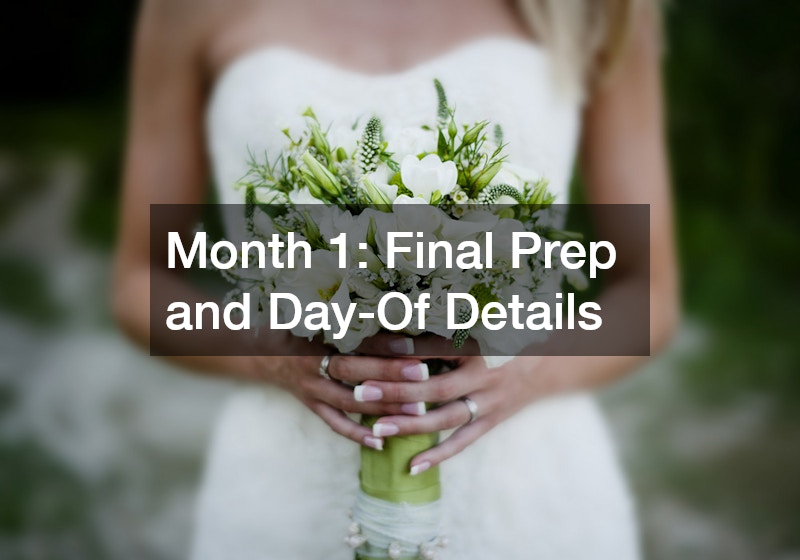
The final stretch is about tightening loose ends, confirming details in writing, and making sure the day itself runs smoothly for both you and your guests.
Audio, Beauty, and the Finishing Touches
Sound and music are easy to underestimate until you’re standing at the altar and your guests in the back row can’t hear a word of your vows. Confirming your audio visual services in this final month — microphones, speakers, and any projection needs for slideshows or livestreaming — ensures your ceremony and reception both come through clearly, and gives you time to do a sound check rather than discovering an issue in real time.
This is also when beauty logistics should be fully locked in. Book your final trial and confirm arrival times with your hair salon or stylist well before the week of the wedding, especially if you’re coordinating a bridal party of multiple people getting ready simultaneously. Ask specifically how long the team expects hair and makeup to take for your full group, then add a 30-minute buffer — getting-ready timelines run long more often than they run short.
In these final weeks, also make sure to:
- Confirm final headcounts with your caterer
- Distribute a printed or digital day-of timeline to your wedding party and vendors
- Pick up or confirm delivery of your attire
- Prepare final payments and tip envelopes ahead of time so nothing is scrambled on the day itself
Frequently Asked Questions About Planning in Six Months
Is Six Months Really Enough Time?
For most couples, yes — as long as you’re realistic about availability. Extremely popular venues, photographers, and bands in major metro areas during peak season (typically late spring through early fall) sometimes book a year or more out, so you may need flexibility on date or vendor choice rather than compromising on the wedding itself. Off-peak seasons and weekday or Sunday dates open up significantly more availability on a compressed timeline.
What Should Get Cut First If the Budget Gets Tight?
Guest count is almost always the most effective lever, since it has a ripple effect across catering, rentals, favors, and even venue size. After that, look at categories with the widest price range for similar quality — florals and rental upgrades (specialty linens, lounge furniture, dramatic lighting) tend to have more flexible pricing than fixed costs like the venue rental fee itself.
How Many Vendors Do Most Couples Actually Hire?
It varies widely by wedding size and style, but most full-service weddings involve somewhere between eight and twelve vendors once you count venue, catering, photography, florals, music, hair and beauty, transportation, and rentals. Keeping a single shared document with every vendor’s contact information, deposit amount, and final payment due date is one of the simplest ways to stay organized as that number grows.
Do We Need a Wedding Planner on This Timeline?
Not necessarily, but a day-of coordinator is worth strongly considering even if you’re planning everything yourselves. Having one dedicated person managing the timeline, vendor arrivals, and any last-minute hiccups means you and your families can actually be present for the day instead of fielding logistical questions.
Bringing It All Together
A six-month engagement can absolutely produce the wedding you’ve been picturing — the timeline just rewards a specific kind of discipline: big, expensive, high-lead-time decisions first, personal and creative details in the middle, and logistics tightened up at the end. Keep your guest count and per-person costs in view from day one, treat your venue booking as the decision that sets your pace, and build in buffer time wherever custom work, seasonal sourcing, or vendor availability is involved.
Most importantly, remember that every couple’s six months looks a little different. Use this framework as a starting point, adjust it to your venue, your guest list, and your priorities, and don’t be afraid to lean on experienced vendors — they’ve navigated this exact timeline more times than you have, and their guidance is often the fastest shortcut to a day that feels calm instead of chaotic.